
State board admission for the session 2026-27, like for the Delhi State Board, usually starts from March to April. The government schools offer free education, while private schools charge around ₹500 to ₹3,000 on a monthly basis. Also, the state board schools focus on regional exams, but CBSE and ICSE prioritize national competitive exam readiness.
Parents who are planning to enroll their child for the 2026-27 academic session often get confused between the State Boards, CBSE, and ICSE. As each board follows a different curriculum, syllabus, and admission process, it can be overwhelming for them to make a final decision. But, with all the important information in one place, such as curriculum, admission process, fees, syllabus, recognition, and more, it can become easy for them to choose the best among many schools for their child’s better future.
- What is a State Board School?
- State Board vs CBSE vs ICSE (Syllabus, Fees, Recognition)
- Major State Boards in India
- Maharashtra State Board of Secondary and Higher Secondary Education (MSBSHSE)
- Uttar Pradesh Madhyamik Shiksha Parishad (UPMSP)
- Tamil Nadu State Board of School Education
- Bihar School Examination Board (BSEB)
- West Bengal Board of Secondary Education (WBBSE)
- West Bengal Council of Higher Secondary Education (WBCHSE)
- Karnataka School Examination and Assessment Board (KSEAB)
- Board of Secondary Education, Rajasthan (BSER)
- Admission Process & Eligibility
- Fee Structure (State Board vs Private vs CBSE/ICSE)
- Pros & Cons of State Board Schools
- How to Switch from State Board to CBSE/ICSE?
- Conclusion
- Frequently Asked Questions:
What is a State Board School?
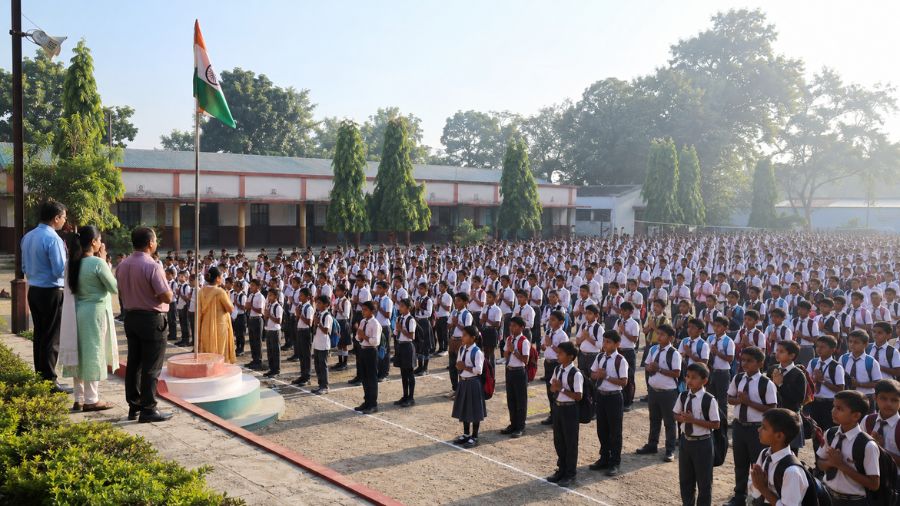
A state board school is an educational institution that is governed and managed by the respective governments of the state. Each state government has its dedicated Department of Education that regulates academic curriculum, textbooks, and conducts examinations as per the regional culture and language.
State Board vs CBSE vs ICSE (Syllabus, Fees, Recognition)
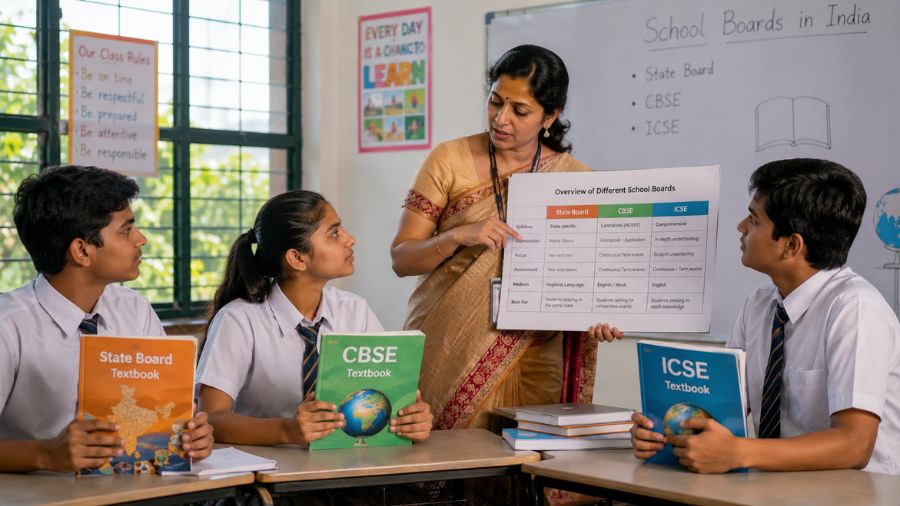
State Board, CBSE, and ICSE are three different types of boards. Each board provides education to children under a different curriculum, fee structure, and learning systems.
- State Board: Follows a curriculum that is based on the state’s language and culture.
- CBSE: Based on the NCERT curriculum with a heavy focus on Mathematics and Science.
- ICSE: Structured to provide global exposure by focusing on language, arts, and sciences.
Look at the table below to know the major differences of State Board vs CBSE vs ICSE based on syllabus, fees, recognition, difficulty level, and transfers:
| Feature | State Board | CBSE | ICSE |
|---|---|---|---|
| Syllabus | State-specific curriculum with a focus on regional language. | National curriculum with balanced academics. Strong focus on JEE, NEET, and CUET preparation. | Detailed curriculum with focus on English, practical learning, and analytical thinking. |
| Fees | Low-to-moderate fees, especially in government schools. | Moderate fees. Affordable in most private schools. | The fees remain high in the ICSE-affiliated schools. |
| Recognition | Recognized by state governments and university acceptance across India. | Recognized nationally and internationally. | Highly recognized in India and abroad. |
| Difficulty Level | Low to moderate difficulty. | Moderate difficulty with a highly structured curriculum. | Difficult, but the syllabus offers greater academic depth with potential workload. |
| Transfers | Easy to transfer within the same state, but difficult across different states. | Easy to transfer between CBSE schools anywhere in India. | Transfers can be difficult due to fewer ICSE schools in India. |
Major State Boards in India
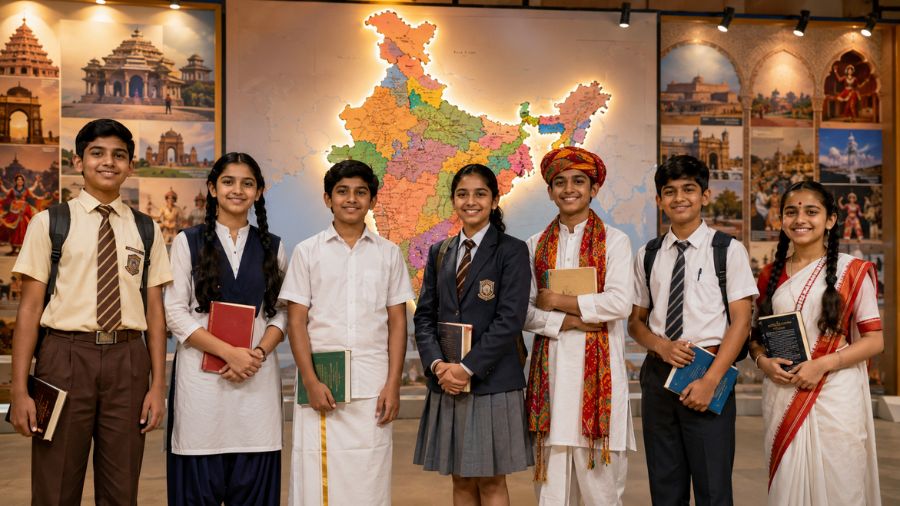
The major state boards in India, including Maharashtra, UP, Tamil Nadu, Bihar, West Bengal, Karnataka, and Rajasthan, are run by their respective state governments. They all have their own diverse curricula, according to regional language, culture, and state competitive exams, while complying with the national educational standards.
Go through the major state boards of India:
Maharashtra State Board of Secondary and Higher Secondary Education (MSBSHSE)
The Maharashtra State Board, or MSBSHSE, was established under the Maharashtra Secondary Board Act of 1965. It is headquartered in Pune and is responsible for designing the curriculum and academic standards, and for conducting the SSC for class 10 and the HSC for class 12.
Examinations:
The Maharashtra board operates through 9 dedicated divisional boards, conducting exams for over 3 million students every year. Here are those 9 divisions:
- Pune
- Mumbai
- Nagpur
- Chhatrapati Sambhajinagar (Previously Aurangabad)
- Kolhapur
- Amravati
- Nashik
- Latur
- Konkan
Grading System:
- Distinction: 75% and above
- First Class: 60% to 74%
- Second Class: 45% to 59%
- Pass Class: 35% to 44%
- Fail: Below 35% (needs a supplementary examination)
Uttar Pradesh Madhyamik Shiksha Parishad (UPMSP)
Uttar Pradesh Madhyamik Shiksha Parishad (UPMSP), which is also known as the UP Board, was established in 1921 under the United Provinces Legislative Council. The UP board manages all academic operations for over 29,000 affiliated schools across the state.
The UP Board has 5 regional offices that handle the state’s 18 administrative divisions, which are:
- Meerut
- Bareilly
- Prayagraj (Previously Allahabad)
- Varanasi
- Gorakhpur
Main Responsibilities:
- Curriculum and Syllabi: Provides a structured curriculum and study materials for classes 1 to 12, and defines academic standards.
- Exams and Management: The UP Board also conducts the high school exams for class 10th and intermediate exams for class 12th.
- Academic Study Resources: It also releases monthly study material, model papers, and question banks to help students in exam preparation.
Note: The UP Board school admissions are generally conducted in February and March. The results are released in late May or June on the UPMSP Result Platform. Also, the students who have secured 33% in every subject can proceed further in the admission process.
Tamil Nadu State Board of School Education
Tamil Nadu State Board of School Education, or famously recognized as the Tamil Nadu State Board, is among the major state boards in India. As one of the oldest school boards in India, it manages the curriculum, affiliation, registration, and academic operations of many government, aided, and private schools across the state.
Furthermore, under the Directorate of Government Examinations, the Tamil Nadu Board handles 7 regional divisions in the state, including:
- Chennai
- Madurai
- Coimbatore
- Tiruchirappalli
- Tirunelveli
- Cuddalore
- Vellore
Moreover, the curriculum, pedagogy, and textbook publication are managed by the Tamil Nadu Council of Educational Research and Training. It maintains a high-quality and standardized education system across all the schools that are affiliated with the Tamil Nadu Board.
Bihar School Examination Board (BSEB)
Bihar School Examination Board (BSEB) was formed under Section 3 of the Bihar School Examination Board Act of 1952. Operating under the Government of Bihar, the BSEB handles curriculum, textbook syllabus, and annual assessments for both government and private schools.
The BSES is headquartered in Patna and is in charge of conducting Matric exams for class 10th and Intermediate exams for class 12th. These exams are held in February with supplementary exams in May and August.
Additionally, the Bihar Board or BSEB operates 9 regional divisions, spread across the state, including:
- Patna
- Tirhut
- Saran
- Darbhanga
- Kosi
- Purnia
- Bhagalpur
- Munger
- Magadh
West Bengal Board of Secondary Education (WBBSE)
West Bengal Board of Secondary Education (WBBSE) was founded in 1951 under the WBSE Act of 1963. It is situated in Nivedita Bhavan, Salt Lake, Kolkata, and conducts exams (Madhyamik Pariksha) for class 10th.
The WBBSE sets curricula, syllabi, and oversees textbook publishing for up to class 10th students. The board performs its academic responsibilities for thousands of government, aided, and private schools in West Bengal.
Moreover, this board introduces the First Language, Second Language, Mathematics, Physical and Life Sciences, History, and Geography as compulsory subjects in the curricula of schools, with other optional subjects.
West Bengal Council of Higher Secondary Education (WBCHSE)
West Bengal Council of Higher Secondary Education (WBCHSE) was established under the WBCHSE Act of 1975 for the senior secondary education from classes 11th and 12th, adopting the 10+2 system.
Also, the headquarters of the WBCHSE is located in Salt Lake, Bidhannagar, Kolkata, and operates 4 other regional offices in the state, making the West Bengal board admission process simple for parents.
Moreover, the board assessment pattern for the 12th-class students includes MCQ-based evaluation for Semester 3 and a Description evaluation for Semester 4. The exams are conducted in February every year, in which students have to score a minimum passing mark of 30 out of 100.
Karnataka School Examination and Assessment Board (KSEAB)
The Karnataka School Examination and Assessment Board (KSEAB) was originally founded in 1966. It merged with the Department of Pre-University Education in October 2022 to conduct SSLC exams for class 10th and PUC exams for class 12th.
The KSEAB has 4 administrative divisions across Karnataka, which include:
- Bengaluru
- Belagavi
- Kalaburagi
- Mysuru
In addition, unlike other state boards in India, the Karnataka State Board follows a three-exam system. The first is constructed in March and April, the second one in May, and the third in June.
This progressive system allows students to achieve the highest marks from any of these three attempts. In other words, they can improve their scores without repeating the academic year.
Board of Secondary Education, Rajasthan (BSER)
Established in 1957 in Jaipur, before shifting its headquarters to Ajmer in 1961, the Board of Secondary Education, Rajasthan (BSER) manages over 6,000 schools in 2026. These school types include both government and private schools present in the state.
The Rajasthan Board or BSER makes the curriculum, textbook syllabus, provides school affiliations, and conducts state-wide exams all over Rajasthan. Apart from school exams, this board also conducts scholarship and competitive exams, such as:
- Chief Minister Higher Education Scholarship Scheme
- State Talent Search Examination (STSE)
- National Means-cum-Merit Scholarship (NMMS)
- National Talent Search Examination (NTSE)
- RTET and REET
Admission Process & Eligibility
The admission process in the schools affiliated with the State Board, CBSE, and ICSE is mostly common, consisting of form filling online or offline, submitting documents, and confirming admission by paying fees.
However, there are main differences in the admission process and eligibility needed for admission in the State Board, CBSE, and ICSE schools.
Common Age Criteria: All schools follow a main age criteria regulation under the New Education Policy (NEP). It makes it compulsory for a child to be at least 6 years old to secure admission in class 1.
Admission Process of State Board, CBSE, and ICSE Schools:
- Confirm Eligibility Whether it is CBSE, ICSE, or state board admission, you must check your child’s eligibility requirements for the specific school.
- Application Submission
- Applications for school admission are released online on the specific school portal and offline as well.
- Fill out the application form and pay the required fees.
- Documents Needed During the application, parents are required to gather the following documents:
- Birth Certificate of the child
- Address Proof
- Passport-sized photo of the child and parents
- Previous School Report Card
- Transfer Certificate (TC)
- Medical Fitness Certificate
- Category Certificates (EWS, SC, ST, OBC, and CWSN)
- Assessment
- Pre-Primary: Many schools assess children’s behavior through play-based tests where parents are asked to play with their child.
- Higher Classes: If your child needs admission in higher classes, an entrance test and an interview may be held in many schools.
- Selection Children and students who pass the assessment of the specific school are informed through the school’s website, email, SMS, or notice board. After this, the parents are asked to pay the fees to confirm the admission.
Note: Some steps in the admission process, including eligibility requirements, differ for State Board, CBSE, and ICSE schools. So, make sure you check this information on the school’s website or by visiting it directly.
Fee Structure (State Board vs Private vs CBSE/ICSE)
The fees of schools affiliated with the State Board, CBSE, and ICSE differ in many aspects, from admission fees to examination fees, activity fees, lab fees, books, and uniform fees. Also, in many government schools, the children can get a good education either at minimal or no fees.
Here is a table consisting of fee aspects in State Board schools (government and private), CBSE, and ICSE-affiliated schools:
| Fee Type | State Board Schools (Government) | Private Schools (State Board) | CBSE and ICSE Schools |
|---|---|---|---|
| Admission Fee | Free or nominal | Moderate | Moderate to High |
| Annual Tuition Fee | Free or very low | ₹10,000 to ₹60,000 | ₹30,000 to over ₹2,50,000 |
| Development and Infrastructure Fee | Usually not charged | May be charged | Commonly charged |
| Examination Fee | Minimal | Moderate | Moderate to High |
| Books & Uniform | Often subsidized or provided in some states | Paid by parents | Paid by parents |
| Transport Fee | Usually not available | Optional (extra) | Optional (extra) |
| Activity, Lab, and Technology Fee | Minimal or none | May apply | Commonly charged |
| Total Annual Cost (Approx.) | Free to ₹10,000 | ₹20,000 to ₹80,000 | ₹50,000 to over ₹3,00,000 |
| Scholarships and Fee Concessions | Government schemes available | School-specific | School-specific; some merit and EWS concessions |
| Suitable For | Budget-friendly education | Affordable private education | Students requiring a national and international curriculum and a wide range of facilities |
Note: Many parents find themselves confused in the State Board vs CBSE vs ICSE fees comparison, but now they can visit the Edhippo Academy platform. On this platform, they can not only compare fee structure, but also facilities, infrastructure, curriculum, and more.
Pros & Cons of State Board Schools
Understand the pros and cons of the state boarding schools here:
Pros of State Board Schools
- Schools that are affiliated with state boards are more affordable than CBSE and ICSE schools.
- These schools provide an in-depth exposure to the regional culture, history, and language.
- Compared to CBSE and ICSE schools, there is less academic pressure on the students.
- These schools are highly beneficial for students who want to prepare for state-level government jobs and administrative roles.
Cons of State Board Schools
- The curriculum and syllabus vary from state to state, making it difficult for students who want to relocate or shift frequently.
- Students can prepare for state government job roles, but may find difficulty in national-level competitive exams like JEE and NEET.
- The state board is recognized all over India, but may have little influence as you move out of the state for higher studies.
- Learning in these schools can be based on a rote system and memorization, and not be practical and concept-based.
How to Switch from State Board to CBSE/ICSE?

The process of switching from the State Board to the CBSE and ICSE boards requires some mandatory documents, eligibility requirements to complete, and some common, simple steps to follow.
Follow the steps to switch from the State Board to the CBSE and ICSE boards:
- Select Desired Board Select the desired board that you want your child to study in. Also, whether you choose CBSE or ICSE, keep in mind that CBSE offers a standardized education, while ICSE offers a difficult but practical-based education.
- Check the Class Requirement Students can transition from class 1st to 9th and 11th. Switching boards for classes 10th and 12th is not permitted by the CBSE and ICSE boards.
- Submit Application Submit the application to the school you want for your child, or visit the Edhippo Academy platform to shortlist the best-suited CBSE and ICSE schools anywhere in India. Also, gather the important documents needed to complete the application.
- Admission Process Pay the admission, tuition, and related fees to the school to confirm the admission of your child.
Note: As your child is transitioning from a State Board to a CBSE or ICSE-affiliated school, he/she may need extra support and guidance to adjust to the curriculum, academic structures, and syllabus.
Conclusion
Whether you choose CBSE, ICSE, or State Board admission for your child, it is necessary that you make your decision based on your budget, the school’s curriculum, the child’s future goals, and his/her learning style and pace. State Boards are best for building close relationships with cultural roots, CBSE is for standardized education, and ICSE is ideal for high-level education, which also opens doors for higher studies abroad.
Frequently Asked Questions:
What is the difference between the State Board, CBSE, and ICSE?
State Board schools provide education customized as per the regional language and culture, while CBSE offers a more standardized learning, and ICSE provides a well-rounded education.
Who should choose a State Board school?
You can search for State Board schools near me if you are looking for an affordable education in a regional language and want your child to prepare for state-level government or civil services.
Are State Board certificates valid across India?
Yes, State Board certificates are valid across India.
What are the average fees for State Board schools?
The average fees for State Board schools vary based on the specific state and school.
What documents are required for State Board admission?
The documents that are required for State Board admission in India are:
- Marksheet of class 10th and 12th
- Passing Certificate
- Transfer Certificate (TC)
- Migration Certificate (if needed)
- Aadhaar Card
- Birth Certificate
- Address Proof
- Passport-Sized Photograph
- Category Certificate
- Domicile Certificate (needed to claim state-specific benefits)
- Medical Fitness Certificate
Also Read: Private School Admission Process In India 2026-27: Complete Guide