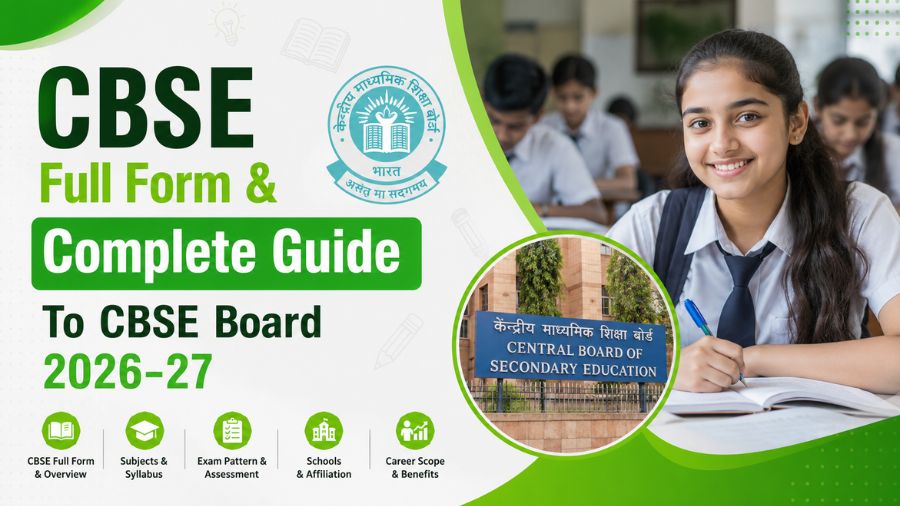

The CBSE full form is the Central Board of Secondary Education. It is a national-level board of education of public and private schools that operates under the Ministry of Education, Government of India. It is renowned for conducting board exams for classes 10th and 12th.
For parents, understanding CBSE goes far beyond its full form. Other aspects, like the curriculum, teaching methods, learning, and assessment systems, help them make the right decision for their child’s future. With a deep knowledge of how CBSE works, how it provides academic learning, and extracurricular activities, parents can evaluate the career opportunities it opens up for their children, building a strong foundation for their future.
- CBSE Full Form & Meaning
- History & Establishment of CBSE
- Objectives & Functions of CBSE
- CBSE Curriculum Structure
- Class-Wise Subjects (NCERT-based)
- CBSE Exams Conducted (AISSE, AISSCE, CTET & link to JEE/NEET)
- CBSE vs ICSE vs State Board (Quick Comparison)
- Why CBSE is Preferred for JEE & NEET Aspirants?
- How to Find a CBSE School Near You?
- Benefits of CBSE for Admission & Transfers
- Conclusion
- FAQs
CBSE Full Form & Meaning
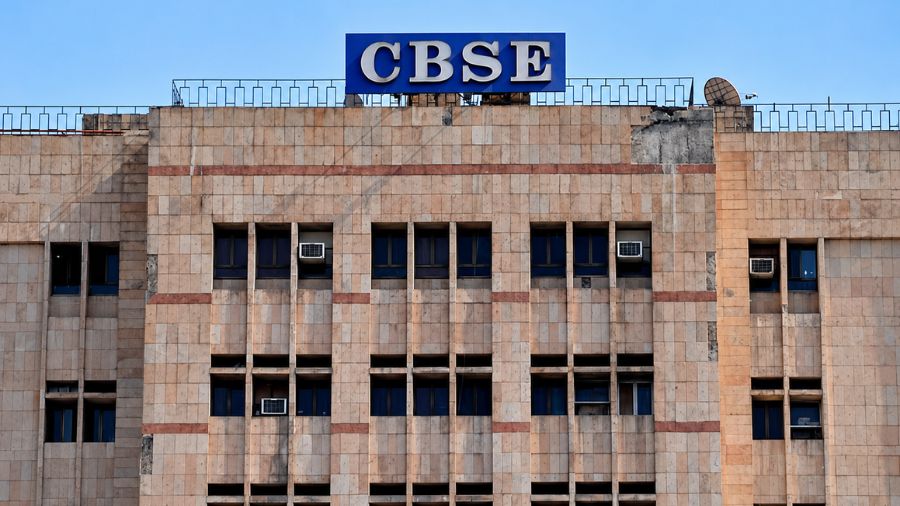
CBSE full form is the Central Board of Secondary Education. It is a national-level board that conducts and monitors the board examinations of classes 10th and 12th across both government and private schools in India. It is named the Central Board because it works under the supervision of the Ministry of Education, Union Government of India.
History & Establishment of CBSE
CBSE traces its origins back more than 100 years. It was founded as the Board of High School and Intermediate Education, aiming to provide a standardized and national-level education.
Pre-Independence (1921 & 1929)
In 1921, the CBSE was founded as the Board of High School and Intermediate Education by the United Provinces of India. Initially, the board was responsible for managing education in Rajputana, Central India, and Gwalior.
In 1929, as a joint board, it was officially renamed as the Board of High School and Intermediate Education, Rajputana, by the Government of India under British rule.
Post Independence (1952 & 1962)
In 1952, after 5 years of independence, the Government of India felt the need to provide education for all children of India, introducing many changes to the board. Therefore, in 1962, it was reconstructed as the Central Board of Secondary Education (CBSE), extending its boundaries beyond Rajputana.
Present Day (2026)
At present, over 28,500 schools across India are affiliated with the CBSE board. The number goes far beyond at the national level, as there are 240 CBSE international schools operating across 28 countries.
Objectives & Functions of CBSE
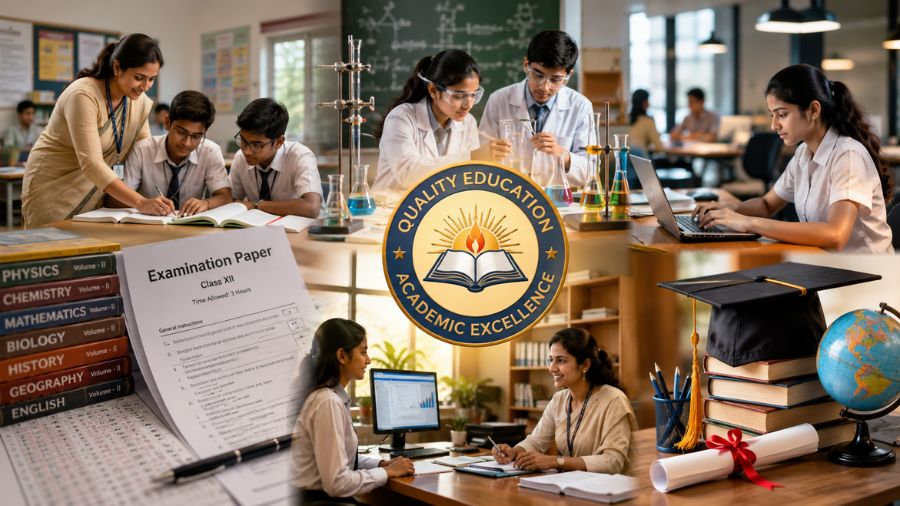
The objectives and functions of the CBSE Board India are to standardize education, conduct examinations, assign curriculum, and ensure holistic learning across thousands of affiliated schools in India.
Primary Objective of CBSE
- Standard Education: To provide a standardized education to students to ensure uniformity in the curriculum and learning methods.
- Holistic Development: To ensure the holistic development of the students by focusing on their intellectual, physical, emotional, and social well-being.
- Competitive Readiness: To build a strong conceptual foundation that helps prepare students for competitive exams such as JEE, NEET, CLAT, NDA, NTSE, KVPY, IMO, and NSO.
Main Functions of CBSE
- Curriculum: To set a uniform curriculum by working with the National Council of Educational Research and Training (NCERT). This curriculum remains the same classes from 1st to 12th in all the affiliated schools.
- Examination Management: To conduct and supervise examinations for Class X (All India Secondary School Examination, AISSE) and Class XII (All India Senior School Certificate Examination, AISSCE).
- School Affiliation: To evaluate and grant affiliation to the private and government schools across India and internationally.
- Vocational Development: Integrating strong vocational developmental learning from classes 6 to 12 to make them job-ready with essential skills.
- Educational Research: To conduct regular reviews of evaluation and pedagogical methods and adapt to innovative and globally recognized practices to improve education.
CBSE Curriculum Structure
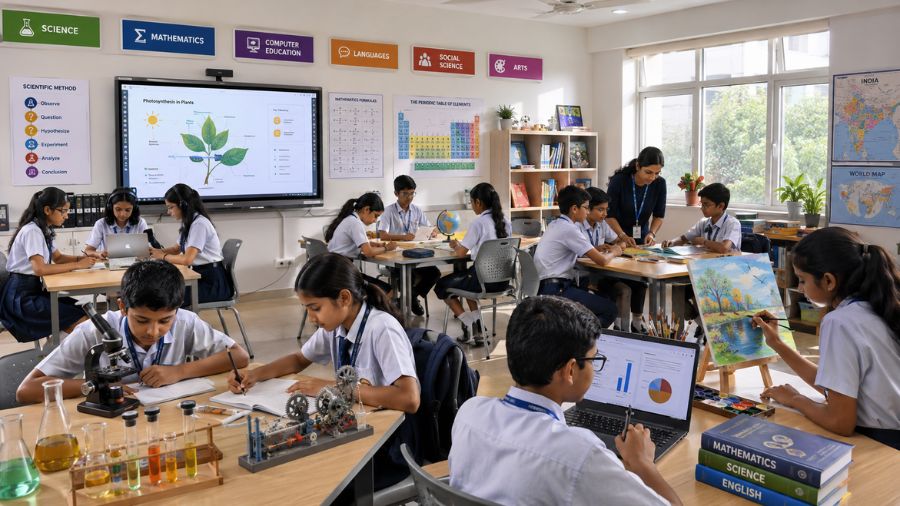
The CBSE board curriculum structure is well-organized across four stages, including Primary, Middle, Secondary, and Senior Secondary.
Primary Stage (Classes 1 to 5)
Main Subjects: English, Hindi (or regional language), Mathematics, and Environmental Studies (EVS)
Focus On: Fundamental literacy development, numeracy, and curiosity through learning based on activities.
Co-curricular Areas: Art Education, Work Experience, and Health and Physical Education.
Middle Stage (Classes 6th to 8th)
Main Subjects: English, Hindi (or a second language), Mathematics, Science, and Social Science (History, Geography, and Civics).
Focus On: Structured discipline-based subjects and conceptual knowledge.
Electives: Inclusion of a third language, like Sanskrit.
Secondary Stage (Classes 9th and 10th)
Main Subjects: English as a first language, a second language, like Hindi or regional, Mathematics, Science, and Social Science.
Focus On: To prepare the students for the 10th board examinations.
Optional and Skill Subjects: Information Technology (IT), Artificial Intelligence (AI), or other academic subjects.
Internal Assessments: Continuous evaluation in Art Education, Health and Physical Education, and Work Experience.
Senior Secondary Stage (Classes 11th and 12th)
Mandatory Language: English Core and Elective are compulsory.
Focus On: Career-oriented education based on a specific stream that students choose.
Streams and Electives:
- Science Stream: Physics, Chemistry, Mathematics, Biology, Computer Science, Biotechnology, or Engineering Graphics.
- Commerce Stream: Accountancy, Business Studies, Economics, Mathematics and Applied Mathematics, and Informatics Practices.
- Humanities (Arts) Stream: History, Political Science, Sociology, Economics, Geography, Psychology, Legal Studies, Fine Arts, and Physical Education.
Class-Wise Subjects (NCERT-based)
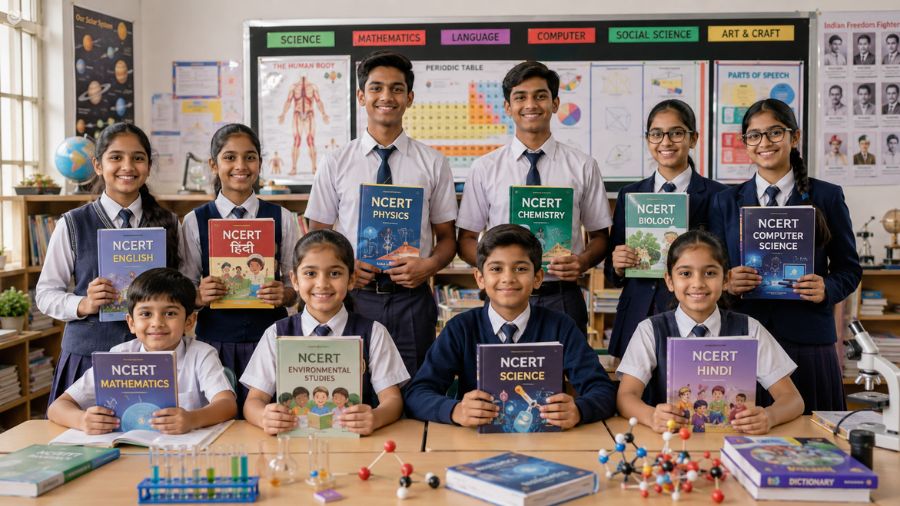
Look at the class-wise subjects based on the NCERT curriculum:
Primary Classes (1st to 5th)
- English: Reading, writing, and phonics foundations.
- Hindi: Grammar, basic vocabulary, and linguistic expression.
- Mathematics: Numbers, basic arithmetic operations, and shapes.
- Environmental Studies (EVS): Introduces foundational science, nature, and social surroundings.
Middle Classes (6th to 8th)
- English and Hindi: Advanced literature, structural grammar, and comprehension.
- Mathematics: Integers, fractions, geometry, and algebra.
- Science: Four foundational modules, including Physics, Chemistry, and Biology.
- Social Science: History, Geography, and Political Science (Civics).
Secondary Classes (9th and 10th)
- Languages: English, Hindi, or a regional language.
- Mathematics: Advanced algebra, coordinate geometry, and trigonometry.
- Science: Physics, Chemistry, and Biology are taught as distinct sections in a single textbook.
- Social Science: Contemporary India, democratic politics, economics, and world history.
Senior Secondary (11th and 12th)
Science Stream
- Physics: Mechanics, thermodynamics, electromagnetism, and optics.
- Chemistry: Organic, inorganic, and physical chemistry.
- Mathematics: Calculus, vectors, and linear programming.
- Biology: Genetics, ecology, and human physiology.
Commerce Stream
- Economics: Microeconomics, macroeconomics, and Indian economic development.
- Accountancy: Double-entry bookkeeping, financial statements, and company accounts.
- Business Studies: Principles of management, marketing, and finance.
Humanities and Arts Stream
- History: Themes in world history and Indian history.
- Political Science: Indian constitution, political theory, and international relations.
- Geography: Physical and human geography.
- Sociology and Psychology: Study of society, human behavior, and cognitive processes.
CBSE Exams Conducted (AISSE, AISSCE, CTET & link to JEE/NEET)
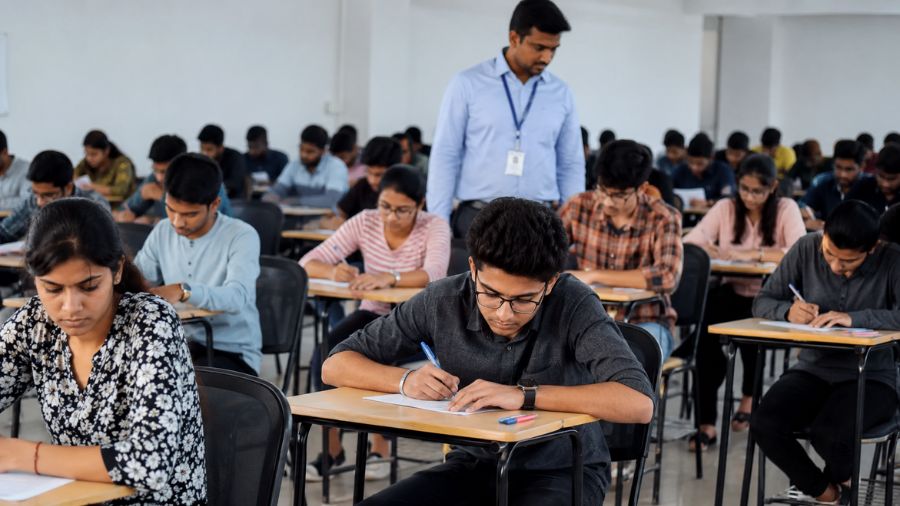
The CBSE Board India conducts examinations for the All India Secondary School Examination (AISSE), All India Senior School Certificate Examination (AISSCE), and Central Teacher Eligibility Test (CTET).
Also, the examinations of JEE and NEET are conducted by the National Testing Agency (NTA), not CBSE. Although its curriculum does help students to prepare for JEE and NEET.
All India Secondary School Examination (AISSE)
Target Class: 10th
Main Subjects: Mathematics, Science (Physics, Chemistry, Biology), Social Science (History, Geography, Political Science, Economics), and two languages.
Grading System: Grading is based on the Cumulative Grade Point Average (CGPA) system.
All India Senior School Certificate Examination (AISSCE)
Target Class: 12th
Main Subjects: One language subject with four elective subjects, from Science, Commerce, or Humanities streams.
Exam Pattern: Each subject is evaluated out of 100 marks. Also, 20 marks out of 100 for practical assessments are given by the school, helping students score higher.
CBSE vs ICSE vs State Board (Quick Comparison)
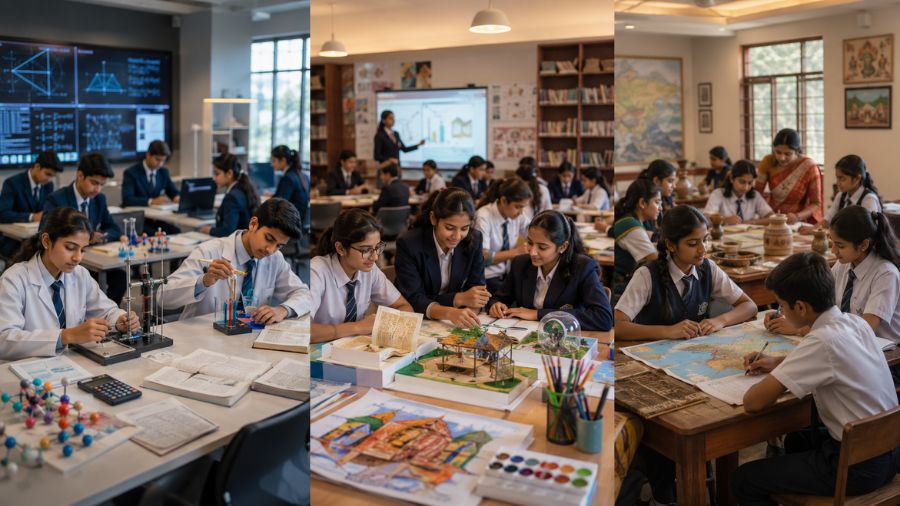
Look at the comparison of CBSE vs other boards, including ICSE (Indian Certificate of Secondary Education) and State Board.
| Feature | CBSE (Central Board of Secondary Education) | ICSE (Indian Certificate of Secondary Education) | State Board |
|---|---|---|---|
| Focus Area | Math, Science, and national competitive exams | In-depth knowledge, English fluency, and Arts | Regional culture, languages, and overall balance |
| Syllabus | Standardized, highly structured, and lighter | Vast, detailed, and application-oriented | Varies by state; usually textbook-focused |
| Difficulty Level | Moderate (generally considered easier for competitive exams) | High (often requires extensive reading and writing) | Easier to manage, leaves time for other activities |
| Grading and Exams | Objective-based, CGPA options | Internal assessments, project-heavy | Traditional percentage system |
| Global Acceptance | Widely recognized | Highly favored by international universities | Primarily recognized in India |
| Transferability | Easiest across India (most common) | Harder (fewer schools outside major cities) | Easiest within the specific state |
Why CBSE is Preferred for JEE & NEET Aspirants?

The Central Board of Secondary Education, or CBSE Board India, is highly preferred across India for the JEE and NEET competitive readiness, because it serves as a foundation for these exams. The exam pattern of JEE and NEET is based on the curriculum of NCERT with a deep focus on conceptual knowledge.
NCERT Alignment
The exam pattern and questions asked in the Joint Entrance Examination (JEE) and the National Eligibility cum Entrance Test (NEET) are based on the NCERT textbooks and syllabus.
Conceptual Clarity and Application
HOTS and MCQs: CBSE exams include questions of Higher Order Thinking Skills (HOTS), case studies, and practical application problems to test students’ analytical thinking and problem-solving.
Entrance Exam Match: The questions that are asked in JEE and NEET exams are similar to MCQs and tricky numerical problems that are also asked in CBSE exams.
High Success Rate
Students who study under the CBSE Board in India show a high success rate and secure top seats in institutions like IITs and AIIMS. This makes the CBSE a highly preferred board.
How to Find a CBSE School Near You?
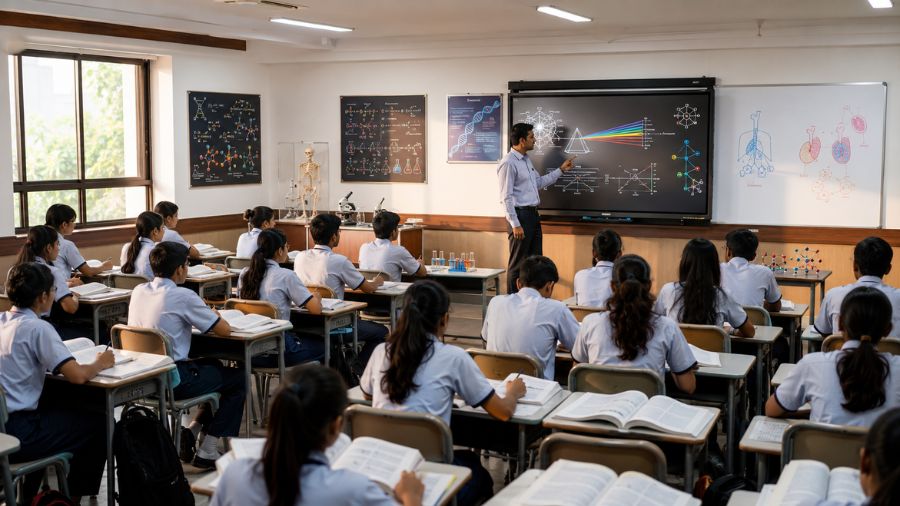
Here is how you can find a CBSE-affiliated school near you:
- Visit the SARAS Portal: Visit the School Affiliation Re-Engineered Automation System (SARAS) official portal, which is saras.cbse.gov.in.
- Click on Information: Find the “Affiliated Schools” link on the dashboard of SARAS.
- Use Search Filters: Select your state, district, and region to find the nearest CBSE school.
- Explore the List: By clicking on search, you will be directed to the CBSE-affiliated schools in your area.
By this method, you can find CBSE schools nearby, but the portal may lack information regarding the fee structure, teacher-student ratio, extracurricular activities, infrastructure, and more. That is why you must consider visiting the EdHippo Academy platform, which provides you with all the information in detail, from location to fee structure.
Benefits of CBSE for Admission & Transfers

Here are the benefits of the CBSE Board India in terms of admission and transfers:
- Easy Transfers: Parents do not worry about transfers, as the curriculum is the same nationwide.
- No Need to Repeat the Same Year: Moving between academic years is easy. Students are not required to repeat the same year.
- International Presence: CBSE is not only recognized in India but also across 28 countries worldwide.
- Widespread Availability: CBSE schools are available all over India with standardized and high-quality education.
- Balanced Syllabus: The CBSE offers a balanced syllabus, reducing pressure and giving students the scope to pursue extracurricular activities.
Conclusion
The Central Board of Secondary Education (CBSE) is a nationwide and internationally recognized board that defines the curricula, syllabi, and assessment guidelines for all affiliated schools across over 28,500 schools in India. It works with the NCERT to make a standardized learning system for primary, middle, secondary, and senior secondary classes.
It follows a holistic method of education, providing students with high-quality academics while also covering co-curricular disciplines to ensure a well-rounded development of the child.
EdHippo Academy is a reputable platform that helps parents search, compare, and connect with the CBSE day and boarding schools. With advanced search filters, parents can find the best CBSE-affiliated schools in their nearby area. They can also explore information such as fee structure, curriculum, teacher-student ratio, facilities, infrastructure, extracurricular activities, and more.
Our team also provides personal support in searching and submitting an application for admission, ensuring a smooth experience with consistent support. Therefore, contact us today and find the best CBSE-affiliated schools for a better future for your child.
FAQs
What is the CBSE full form?
The CBSE full form is Central Board of Secondary Education.
Does CBSE have schools outside India?
Yes, CBSE has affiliated schools outside India, in around 28 countries.
What does the CBSE board meaning in simple words?
The CBSE board is a national education board that provides standardized education across affiliated schools in India.
How is CBSE vs other boards different?
The CBSE vs other boards like ICSE and State Board differ in terms of curricula, education methods, learning systems, focus of education, exam pattern, and competitiveness.
Is the CBSE syllabus helpful for JEE and NEET preparation?
Yes, the CBSE syllabus is helpful for JEE and NEET preparation.
Also Read: Navodaya Vidyalaya (JNV) Admission 2026-27: Class 6 & 9 Entrance Exam Guide