
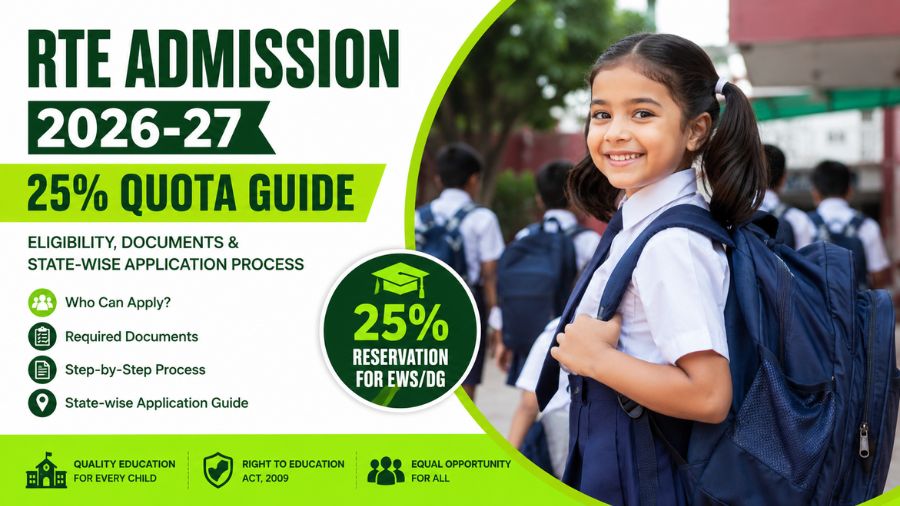

The Right to Education (RTE) Act makes it mandatory for children from Economically Weaker Sections (EWS) and Disadvantaged Groups (SC, ST, OBC, orphans) to get free admission under a 25% quota in entry-level classes. Therefore, parents trying to enroll their children in classes like Nursery, LKG, or Class 1 can benefit from this in the best way possible. It makes education free for eligible children by finalizing their admission through computerized lotteries.
Economically weaker families and disadvantaged groups who are thinking of enrolling their children in the entry-level classes can consider making the most of this Right to Education (RTE) Act. It allows children to study in good private schools without paying tuition fees. However, the children need to be eligible to get a seat under this quota. For parents seeking RTE admission, let’s take a closer look at the eligibility rules, age criteria, required documents, and state-wise application process before applying.
- What is the RTE 25% Quota (Right to Education Act 2009)?
- Who is Eligible (EWS & Disadvantaged Group Criteria)?
- Age Criteria & Cut-off Date (NEP 2020 Norms)
- Income Certificate & Other Documents Required
- State-wise RTE Application Process & Portals
- State-Wise Portals For RTE Admission
- Delhi, Maharashtra, UP, Karnataka RTE Admission Dates 2026-27
- Lottery/Selection Process & How to Check Result
- What RTE Covers (Fee Waiver Till Class 8)
- Common Rejection Reasons & How to Avoid Them
- Conclusion
- Frequently Asked Questions (FAQs)
What is the RTE 25% Quota (Right to Education Act 2009)?

The Government of India has introduced the Right to Education (RTE) Act, 2009, to provide free and mandatory education to children between the age group of 6-14 years. Under Section 12(1)(c) of the Act, it is mandatory for all eligible private unaided schools to keep 25% of seats in entry-level classes, such as Nursery, LKG, UKG, or Class 1. This act has been passed for Economically Weaker Sections (EWS) and Disadvantaged Groups (DG). Therefore, chosen students will receive free education up to Class 8.
Who is Eligible (EWS & Disadvantaged Group Criteria)?
RTE 25% Quota is specifically for Economically Weaker Sections (EWS) and Disadvantaged Groups (DG). Here is a complete overview of the eligibility conditions to qualify.
| Eligibility Criteria | Details |
|---|---|
| Eligible Category | The child must belong to the Economically Weaker Section (EWS) or a Disadvantaged Group (DG) such as SC, ST, OBC (where applicable), orphan, or child with disabilities. |
| Age for Nursery | The child should generally be 3 to 4 years old as on the state’s prescribed cut-off date. |
| Age for LKG | The child should generally be 4 to 5 years old. |
| Age for Class 1 | The child should generally be 6 to 7 years old. |
| Cut-off Date | Most states calculate the child’s age as on 1 April or 31 March of the admission year. Parents should check their state’s official notification. |
| Annual Family Income (EWS) | The annual family income should be within the limit fixed by the respective state government. This typically ranges between ₹1 lakh and ₹5 lakh per year, depending on the state. |
| Distance from School | Preference is usually given to children living within the distance radius specified by the school’s state, typically 1 to 5 km, though the exact distance rule differs from state to state. |
| Required Documents | Parents must submit valid documents such as the child’s birth certificate, income certificate, address proof, and category certificate (if applicable). |
Note: There might be differences in the income limits and eligible categories from one state to another. It is important for parents to check the latest updates on RTE guidelines issued by their respective state education department.
Age Criteria & Cut-off Date (NEP 2020 Norms)
Children who are seeking admission under the RTE 25% quota must fulfill the required RTE age limit criteria as prescribed by the respective state government. Most states adhere to the National Education Policy (NEP) 2020 age guidelines for entry-level admissions. Here is a complete breakdown:
| Class | Recommended Age | Common Cut-off Date |
|---|---|---|
| Nursery | 3+ years | Usually 31 March |
| LKG | 4+ years | Usually 31 March |
| UKG | 5+ years | Usually 31 March |
| Class 1 | 6+ years | Usually 31 March |
Income Certificate & Other Documents Required
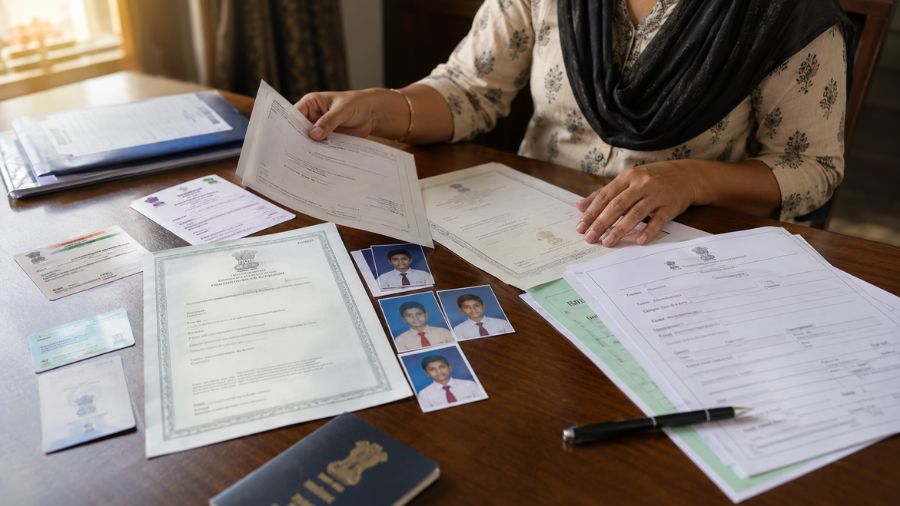
To get admission under the 25% RTE category, parents must provide valid documents. These include an Income Certificate, which is usually issued by a Revenue Department, Tehsildar, or SDM. This verifies that your total annual family income is below the state-prescribed limit. Generally, the income should range between ₹1 Lakh and ₹5 Lakh depending on your state.
Apart from the income certification, you also need the following documents:
- Child’s Identity Proof: Documents stating the child’s identity are important. These include a Birth Certificate, Hospital Report, or an Aadhaar Card.
- Residence Proof: Aadhaar Card, Voter ID, Ration Card, electricity/water bills, or a registered rent agreement. The residence usually must be within a 1 to 5 km radius of the applied school.
- Parents’/Guardian’s ID Proof: Aadhaar Card of both parents.
- Category Certificates (if applicable): Caste Certificate (SC/ST/OBC), Disability Certificate (for CWSN), or relevant documents for orphans/HIV-affected children.
- Passport Size Photographs: Recent photographs of the child.
Note: The document formats, income range, and application deadlines may differ depending on the states. To verify the exact requirements, you can visit the local state’s official Department of Education portal. For example, if you live in Delhi, you can visit the Delhi Directorate of Education or your state’s RTE portal.
State-wise RTE Application Process & Portals

The RTE admission process is conducted entirely online through the official Education Department or RTE portal of each state. Here are some basic steps for the application process that remain the same in every state.
- Visit the Official RTE Portal: Go to your state’s official RTE admission portal and read the admission guidelines and RTE eligibility criteria.
- Register & Fill the Application Form: Create your account and fill in the child’s and parents’ details along with the required information in the RTE admission online form.
- Upload Required Documents: Upload documents such as the birth certificate, income certificate, address proof, Aadhaar card, and category certificate.
- Select Preferred Schools: Choose eligible private schools near your residence according to the distance criteria mentioned by your state.
- Submit the Application: Review the details properly, submit the form, and keep the acknowledgement receipt for future reference.
- Lottery & Admission: If your child is selected through the computerized lottery, visit the allotted school with the original documents to complete the admission process.
State-Wise Portals For RTE Admission

| State/UT | Official RTE Admission Portal |
| Delhi | Delhi Directorate of Education (edudel.nic.in) |
| Maharashtra | RTE Maharashtra Portal (student.maharashtra.gov.in) |
| Rajasthan | RTE Rajasthan Portal (rajpsp.nic.in) |
| Uttar Pradesh | RTE UP Portal (rte25.upsdc.gov.in) |
| Madhya Pradesh | RTE MP Portal (rteportal.mp.gov.in) |
| Gujarat | RTE Gujarat Portal (rte.orpgujarat.com) |
Delhi, Maharashtra, UP, Karnataka RTE Admission Dates 2026-27

The RTE admission timeline is issued separately by each state through its official RTE or Education Department portal. However, the exact dates may change every year; parents should stay updated with their state’s official website so that they do not miss out on the application window. The dates below should be independently confirmed against each state’s official portal before relying on them, as timelines are updated frequently and can vary by admission phase.
| State | Application Window (2026-27) | Admission Status / Important Dates | Official Portal |
|---|---|---|---|
| Delhi | Opened 3 February 2026; closed 19 February 2026 for EWS/DG entry-level admissions | Admission to allotted schools to be completed by 20 May 2026. Confirm current status on the official portal. | Delhi Directorate of Education Portal |
| Maharashtra | Verify current status on official portal | Verify current status on official portal | Maharashtra RTE 25% Portal |
| Uttar Pradesh | Phase 1 opened February 2026 | Verify current status on official portal | RTE Uttar Pradesh Portal |
| Karnataka | Verify current status on official portal | Verify current status on official portal | Karnataka School Education Department Portal |
Lottery/Selection Process & How to Check Result

If the number of applications exceeds the available seats, the state conducts a computerized lottery to choose eligible children. This process is entirely transparent and provides an equal opportunity to get admission under the 25% RTE Act. Once the lottery results are announced, parents can check the child’s selection status on the official portal. If your child passes the RTE eligibility criteria and gets selected, you can process further admission with the school.
How to Check the RTE Lottery Result
- Visit your state’s official RTE admission portal.
- Click on the Lottery Result, Selection List, or Admission Status option.
- Enter your Application Number, Registration ID, or other required details.
- View your child’s allotment status and download the result, if available.
- If selected, visit the allotted school with the original documents to complete the admission process within the given deadline.
What RTE Covers (Fee Waiver Till Class 8)

Under the RTE 25% quota system, eligible children can get free education up to Class 8 in the allotted private school. Parents need not pay any tuition fees for their child’s education, and other mandatory academic charges are also covered under the Act. This is one of the best opportunities for children from economically weaker families to continue their education without financial stress.
RTE Fee Waiver Covers
- Free tuition fees up to Class 8.
- Admission under the 25% reserved seats in eligible private schools.
- Free elementary education from the entry-level class up to Class 8.
- No admission donation or capitation fee under the RTE quota.
- Equal learning opportunities and school facilities along with other students.
Note: Benefits such as school uniforms, textbooks, transport, meals, and other additional facilities may vary depending on the rules of the respective state government.
Common Rejection Reasons & How to Avoid Them

Many parents face rejection under this act for their child’s admission because of simple mistakes or missing documents. Here are some common reasons for rejection and ways you can avoid them for succesful admission of your child:
| Common Rejection Reason | How to Avoid It |
| Incorrect or incomplete application RTE admission online form | Fill in all the details carefully and double-check before submitting. |
| Missing or invalid documents | Upload clear and valid documents in the required format. |
| Child does not meet the age criteria | Check the RTE age limit and cut-off date before applying. |
| Family income exceeds the prescribed limit | Verify the income eligibility as per your state’s RTE guidelines. |
| Wrong category or incorrect certificate | Select the correct category and upload valid supporting certificates. |
| Residential address outside the eligible distance | Apply to schools that fall within the distance limit specified by your state. |
| Multiple applications for the same child | Submit only one application unless your state’s rules allow otherwise. |
| Missing the application deadline | Complete and submit the application before the last date announced by your state. |
Conclusion
The RTE 25% quota is one of the significant opportunities for children from economically weaker families and disadvantaged groups. They can receive free education in some of the most reputable private schools near them. However, to secure a seat, make sure to understand the eligibility criteria, age limit, documents, and application dates before applying.
For the latest school admission news, RTE updates, and information about schools across India, Edhippo Academy serves as the best school listing platform. Visit the platform now and get all the required information regarding RTE in no time.
Frequently Asked Questions (FAQs)
1. Who can apply for RTE admission?
Children who belong to EWS or eligible disadvantaged groups such as SC, ST, OBC (where applicable), orphans, and children with disabilities can apply if they fulfill all the state guidelines.
2. Is education completely free under the RTE Act?
Yes. Eligible children receive free tuition and elementary education up to Class 8 in the allotted private school under the RTE Act.
3. Which classes are covered under the RTE quota?
The RTE quota is available for entry-level classes such as Nursery, LKG, UKG, or Class 1, depending on the admission policy of the respective state.
4. Can I apply to more than one school under RTE?
Yes. Most states allow parents to select multiple nearby schools during the online application process, according to the state’s admission rules.
5. How can I check my child’s RTE admission result?
You can visit your state’s official RTE admission portal and enter your application number or registration details to check the lottery result or admission status.
Also Read: Kendriya Vidyalaya (KV) Admission & Fee Structure 2026-27: Complete Guide