

Navodaya Vidyalaya (JNV) Admission 2026-27 is done through the Jawahar Navodaya Vidyalaya Selection Test (JNVST). It is conducted by the Navodaya Vidyalaya Samiti (NVS). Students can apply online without paying any fee. The entrance exam has objective questions on mental ability, arithmetic, and language to select eligible students for Class 6 and Class 9.
Getting admission to a good school is a dream for many students, and Navodaya Vidyalaya (JNV) makes that dream possible. Every year, the Navodaya Vidyalaya Samiti (NVS) conducts the JNV Selection Test (JNVST) for Class 6 and Class 9 admissions. Students are selected through an entrance exam, and there is no application fee. Moreover, the schools also offer hostel facilities, good teachers, and many learning opportunities.
Therefore, before applying, it is important to know the eligibility, exam pattern, application process, important dates, and other admission details so you can apply with confidence.
- What is Jawahar Navodaya Vidyalaya (JNV)?
- Eligibility Criteria
- Rural Quota Rules (75% Reservation)
- JNVST Exam Pattern and Syllabus
- Step-By-Step Online Application Process
- Important Dates
- How to Download JNV Admit Card
- How to Check JNVST Result & Merit List
- Previous Year Question Papers
- Fee and Facilities At JNV
- Preparation Tips For Students
- Conclusion
- FAQs (Frequently Asked Questions)
What is Jawahar Navodaya Vidyalaya (JNV)?

Jawahar Navodaya Vidyalaya (JNV) is a government residential school that provides free, quality education to talented students, especially from rural areas. The school system is operated by the Navodaya Vidyalaya Samiti (NVS) It offers CBSE education, hostel facilities, books, uniforms, meals, sports, and other learning opportunities for students who are selected through the JNV Selection Test (JNVST).


Eligibility Criteria
The Navodaya Vidyalaya eligibility rules are different for Class 6 and Class 9 admissions. Students must meet the required age, education, and district eligibility conditions.
| Criteria | Class 6 Eligibility | Class 9 Eligibility |
| Age Limit | Born between 1 May 2015 and 31 July 2017. | Born between 1 May 2011 and 31 July 2013. |
| Educational Qualification | Must be studying in Class 5 during the 2026-27 session in a government, government-aided, recognized private, or NIOS school. | Must be studying in Class 8 during the 2026-27 session in a government or recognized school and must pass Class 8 before admission. |
| District Rule | Must be a resident of the district where applying for JNV. If studying in a nearby district, the school should be within 10 km of the student’s home. | Must be a resident of the district where the JNV is located and should also be studying in the same district. |
| Rural Quota | 75% of the seats are reserved for students who studied in Classes 3, 4, and 5 in rural schools. | Rural quota rules apply as per the admission guidelines issued by NVS. |
Rural Quota Rules (75% Reservation)

In Navodaya Vidyalaya, 75% of the seats are reserved for students from rural areas. The other 25% of the seats are available for both rural and urban students
1. What Is the Rural Quota?
The rural quota helps talented students from villages get a good education. Under this rule, at least 75% of the seats in every JNV are reserved for eligible students who have studied in rural schools.
2. Documents Required
Before filling the JNVST admission form, keep these documents ready.
- Rural Residence Certificate issued by the concerned authority.
- School Study Certificates for Classes 3, 4, and 5, signed by the school head to confirm that the school is in a rural area.
JNVST Exam Pattern and Syllabus

Understanding the JNV Class 6 entrance exam and Class 9 entrance exam patterns can help students prepare better and manage their time during the test.
1. Exam Pattern
| Particulars | Details |
| Mode of Exam | Offline (Pen and Paper) |
| Duration | 2 Hours |
| Total Questions | 80 MCQs |
| Total Marks | 100 Marks |
| Marking Scheme | 1.25 marks for each correct answer |
| Negative Marking | No |
2. Section-Wise Time & Questions
| Section | Questions | Marks | Time |
|---|---|---|---|
| Mental Ability + Environmental Studies | 40 | 50 | 60 min |
| Arithmetic | 20 | 25 | 30 min |
| Language | 20 | 25 | 30 min |
| Total | 80 | 100 | 2 hours |
3. Navodaya Vidyalaya Syllabus
- Mental Ability: This section checks logical thinking and problem-solving skills. It includes topics like patterns, figures, series, coding-decoding, and puzzles.
- Arithmetic: This section tests basic maths concepts such as addition, subtraction, multiplication, division, fractions, decimals, and simple geometry.
- Language Test: The language test checks how well students can read and understand grammar. Students may be asked questions based on comprehension, vocabulary, grammar, and sentence formation.
Step-By-Step Online Application Process

Students can complete the JNVST admission form online by following a few simple steps. Keep all the required documents and details ready before you start the application.
1. Documents Required Before Applying
Keep these documents ready in scanned format (JPG/JPEG, 10 KB to 100 KB).
- Recent passport-size photograph
- Candidate’s signature
- Parent’s/ guardian’s signature
- Aadhaar Card or Residence Certificate (if Aadhaar is not available)
- Certificate signed by the Headmaster/Principal with Class 3, 4, and 5 details.
2. Online Application Process
To apply for Navodaya Vidyalaya admissions 2026-27, follow these simple steps.
- Visit the official website and open the NVS Online Admission Portal.
- Click on the admission link for Class 6 or Class 9 and complete the registration.
- Fill the JNVST application form and enter your personal, academic, and address details carefully, including your State, District, Block, and Aadhaar number.
- Upload the required documents, such as your photograph, your candidate’s signature, your parent’s signature, and the Headmaster’s certificate in the required file size.
- Check all the details carefully before submitting the form. After submission, download and print the confirmation page or registration number for future reference.
Important Dates

Students applying for Navodaya Vidyalaya admission 2026-27 should check the important dates and complete each step on time.
| Event | Date |
|---|---|
| Application Start | 7 July 2026 |
| Last Date to Apply | 31 July 2026 |
| Admit Card Release | November 2026 |
| JNVST Exam Date | 28 November 2026 |
| Expected Result | March/April 2027 |
How to Download JNV Admit Card
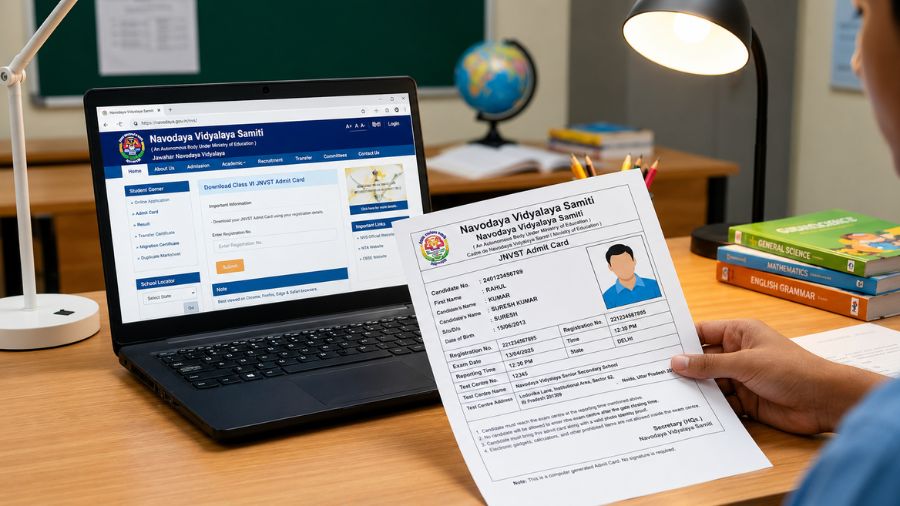
Students appearing for the JNV Class 6 entrance exam must download their admit card before the exam date. You cannot enter the exam centre without the admit card.
1. Step to Download the Admit Card
- Visit the official NVS website.
- Click on the JNVST admit card link for your class.
- Fill in your registration number and date of birth.
- Type the CAPTCHA code and click submit.
- Download the admit card and take printouts for future use.
2. Details Mentioned on the Admit Card
The admit card contains important information such as:
- Candidate’s name and roll number
- Exam centre name and address
- Exam date and time
- Candidate’s photograph and signature
- Exam day instructions
3. What to Do If There Is an Error
If you find any mistake on your admit card, such as a wrong name, date of birth, or photograph, contact your nearest Jawahar Navodaya Vidyalaya or the NVS regional office as soon as possible. Make sure the mistake is corrected before the exam.
How to Check JNVST Result & Merit List

Students who appeared for the JNV Class 6 entrance exam can check their results online by following these simple steps.
- Visit the official NVS website.
- Click on the JNVST Class 6 Result or JNVST Class 9 Result link.
- Enter your Roll Number and Date of Birth.
- Click Submit to view your result.
- Download and print the report card for future reference.
- Open the Admissions section to download the merit list PDF.
- For the merit list, select your NVS Regional Office and search for your name or registration number.
Previous Year Question Papers

Practising previous question papers can improve your preparation for Navodaya Vidyalaya admission 2026-27. It helps students know the exam pattern and prepare better.
1. Why Solve Previous Year Papers?
- Understand the exam pattern and question types.
- Learn to complete the exam on time.
- Find your strong and weak subjects.
- Improve speed and accuracy.
2. How to Download the PDFs
- Visit the official NVS website.
- Open the Admissions section.
- Click on the Previous Year Question Papers link.
- Choose your class and download the PDF.
3. Benefits of Practising Regularly
Regular practice with the Navodaya Vidyalaya syllabus helps students revise important topics, make fewer mistakes, and perform better in the entrance exam.
Fee and Facilities At JNV

Navodaya Vidyalaya offers quality education along with many facilities for students. Most of the expenses are paid by the Government of India, which makes education affordable for families.
- Fee Structure: Education is free for students from Class 6 to Class 8. Students also receive free boarding, lodging, textbooks, uniforms, and other basic facilities.
- Charges for Different Classes: Students from Class 9 to Class 12 usually do not have to pay tuition fees. However, boys in Classes 9-12 (except students from SC/ST categories, Divyang students, and those from Below Poverty Line families) may have to pay a nominal fee as per NVS rules.
- Facilities at JNV: Students studying at Navodaya Vidyalaya get many facilities that support both learning and overall development.
- Separate hostels for boys and girls with proper supervision.
- Nutritious meals are provided every day.
- Well-equipped libraries and science/computer labs for learning.
- Students can take part in sports, cultural programs, art, music, and other activities.
- Basic healthcare and regular medical check-ups are available for students.
Preparation Tips For Students

A few simple study habits can help you prepare better for the JNV Class 6 entrance exam.
- Know the exam pattern before you start studying.
- Set a daily study routine and stick to it.
- Practice mock tests and previous year’s question papers.
- Improve your time management by solving questions within the given time.
- Revise the Navodaya Vidyalaya syllabus regularly to remember important topics and improve your understanding.
Conclusion
Navodaya Vidyalaya gives students a good opportunity to study in a government residential school with quality education and good facilities. By understanding the eligibility rules, exam pattern, application process, and important dates, parents and students can complete the admission process with confidence.
Parents who need trusted information about school admissions, entrance exams, and the best schools in India can visit EdHippo Academy. Our platform provides simple guides, updated information, and expert recommendations, which help families make the right decisions for their child’s future. Start your child’s education journey with confidence by visiting us for trusted school and admission guidance.
FAQs (Frequently Asked Questions)
What is the JNVST exam?
The JNVST (Jawahar Navodaya Vidyalaya Selection Test) is an entrance exam for students who want admission to Class 6 or Class 9 in Navodaya Vidyalaya.
Who can apply for Navodaya Vidyalaya admission 2026-27?
Students who meet the required age, education, and district eligibility conditions can apply for Navodaya Vidyalaya admission 2026-27.
Is there an application fee for JNV admission?
No. Students can apply for JNV admission free of cost.
Is education free in Navodaya Vidyalaya?
Yes. Students receive free education, hostel, books, uniforms, meals, and many other facilities.
Where can I check the JNVST result?
You can check your result on the official NVS website using your roll number and date of birth.
Also Read: Class 11 Admission Process in India 2026-27: Eligibility & Documents